The Breed Standard
A SHORT HISTORICAL OVERVIEW
As printed in the ANKC Breed Standard
According to the official records of the Verein fur Deutsche Schaferhunde (SV) (The German Shepherd Dog Club in Germany) with its headquarters in Augsburg, the standard was originally developed at the first meeting of members in Frankfurt am Main on 20th September 1899 based on the proposals of A Meyer and M von Stephanitz. The next step was to have the breed standard accepted by the VDH (German Kennel Club).
Amendments were made to the standard during the 6th meeting of the association on the 28th July 1901, during the 23rd meeting in Cologne on the 17th September 1909, by the Board of Directors and Advisory Committee in Wiesbaden on the 5th September 1930, and at the Board of Directors and Breed Committee meeting on 25th March 1961. Within the framework of the World Union of German Shepherd Dog Clubs (WUSV), it was revised and confirmed at the WUSV meeting on 30th August 1976 and reviewed, catalogued by authorisation and resolution of the Executive and Advisory Committee on 23rd March 1991. Further amendments were made at the meeting of the federation on 25 May 1997, 31 May 2001/1 June 2011 and 6 & 7 June 2009.
The German Shepherd Dog, whose planned breeding commenced in the year 1899 after the founding of the German Shepherd Dog Club in Germany, was bred from central German and southern German strains of existing herding dogs with a final goal of creating a working dog predisposed to a high working aptitude. In order to reach this goal the breed standard was laid down which relates to physical attributes as well as those of temperament and character.
GENERAL APPEARANCE
The German Shepherd Dog is medium size, slightly elongated, strong and well muscled, the bones are dry and the overall construction firm.
The length of the body is greater than the height at the withers by about 10 to 17%.
CHARACTERISTICS
Purpose and Usage: Versatile Utility, Herding, Guard and Service Dog.
TEMPERAMENT
The German Shepherd Dog must be of well balanced temperament, steady of nerves, self assured, absolutely `at ease (except when provoked) and good natured as well as attentive and easy to train. He must possess instinctive drive, resilience and self confidence in order to be suitable as a companion, watch dog, protection, service and herding dog.
-
The head is wedge-shaped, proportionate in size to the body, (length of head about 40% of height of withers) without being coarse or too elongated, in overall appearance dry and moderately broad between the ears. The forehead is only slightly domed when viewed from front and the side and without any or only slightly indicated central furrow.
The proportion of the skull to muzzle is 50% to 50%. The breadth of the skull corresponds approximately to its length. The skull (viewed from above) tapers evenly from the ears to the nose with a sloping, not sharply defined stop, into the wedge shaped foreface (muzzle). Upper and lower jaws are strongly developed. The top of the muzzle is straight, a dish faced or convex curve is not desired. The lips are tight, well fitted and of a dark colour.
The nose must be black.
-
The eyes are of medium size, almond shaped, slightly oblique and not protruding. The colour of the eyes should be as dark as possible. Light piercing eyes are not desirable as they detract from the expression of the dog.
-
The German Shepherd Dog has erect ears of medium size that are carried upright and almost parallel (not tilted inwards). They taper to a point and are set with the orifice to the front. Tipped ears and drop ears are faulty. Ears carried laid back, during gaiting or when at rest are not faulty.
-
The dentition must be strong, healthy and complete (42 teeth conforming to the dentition formula) the German Shepherd Dog has a scissor bite that is, the incisors must fit scissor-like to each other so that the incisors of the upper jaw overlap those of the lower jaw in a scissor fashion. Level, over or undershot bites are faulty, as well as large gaps between the teeth. It is a fault when the incisors are placed in a straight line in the gums. The jawbones must be strongly developed so that the teeth are embedded deeply in the gum line.
-
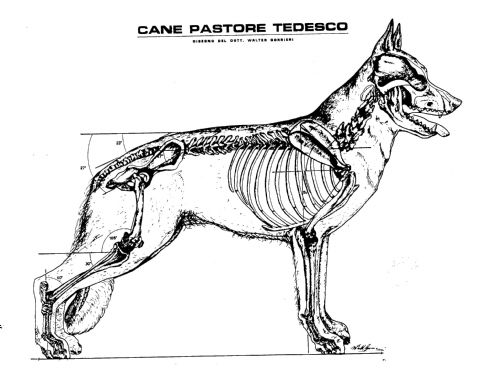
The neck should be strong, and well muscled and free from throatiness (dewlap) the angle to the body (horizontal) is approximately 45 degrees.
-
The forelegs are straight viewed from all sides, and when viewed from front must be absolutely parallel.
The shoulder blade and upper arm are of equal length and firmly attached to the body with strong musculature. The angulation of the upper arm and shoulder blade ideally should be at 90 degrees but generally up to 110 degrees.
The elbows must be neither turned in nor turned out while in stance or in movement. The forearms when viewed from all sides are straight and absolutely parallel, dry and firmly muscled. The pastern is approximately one third of the length of the forearm and has an angle of approximately 20 degrees to 22 degrees to the forearm. Both infirm (more than 22 degrees) as well as steep pasterns (less than 20 degrees) restrict the working ability of the dog and in particular its endurance.
-
The topline flows from the set on of the neck, over the high long withers and over the straight back to the slightly sloping croup without a noticeable break. The back is moderately long, firm, strong and well muscled. The loin is broad, short, strongly developed and well muscled. The croup should be long and slightly sloping (approximately 23 degrees to the horizontal) into the set on of the tail without disruption to the topline.
The chest should be moderately broad; the underchest is as long as possible and well developed. The depth of chest should be approximately 45% to 48% of the height at the withers.
The ribs should be moderately sprung, barrel-chested is equally faulty as slab sided.
Skin: The skin is (loosely) fitting however without any folds.
-
The position of the hind legs is slightly set back, when viewed from rear the hind legs are parallel to each other. Upper and lower thighs are of almost equal length and form an angle of approximately 120 degrees, the thighs are strong and well muscled.
The hock joints are well developed and firm, the rear pasterns stand perpendicular under the hock joint.
-
The front feet are rounded, well closed and arched. The pads are hard but not inflexible. The nails are strong and dark in colour.
The hind feet are closed slightly arched; the pads are hard and dark in colour. The nails are strong, arched and also dark in colour.
-
The tail extends to at least the hock joint, however, not beyond the middle of the rear pastern. It has slightly longer hair on the underside and is carried in a gentle hanging curve when relaxed. It can be carried higher when excited or during movement but not above the horizontal. Corrective surgery is forbidden.
-
The German Shepherd Dog is a trotter. The limbs must be of such length and angulation that the hindquarter may be thrust well forward under the body and the forequarter reaches equally far forward without noticeable change to the backline.
Any tendency towards over-angulation of the hindquarter decreases the firmness and endurance and therefore the dog's utmost working ability. Correct structural proportions and angulations result in a ground covering, low to the ground movement that gives the impression of effortless forward propulsion. With the head pushed forward and a slightly raised tail, an even, balanced and smooth trot, results in a gently curving and unbroken topline, running from the tips of the ears and over the neck and back through to the end of the tail.
-
The German Shepherd Dog is bred in the coat varieties: stock coat (normal) and long stock coat, both with undercoat.
Stock Coat (normal):
The top coat should be as dense as possible, straight, harsh and close lying. It should be short on the head, including the inside of the ears, the front of the legs, and on the feet and toes; it is a little longer and heavily coated on the neck. The hair lengthens on the back of the legs to the pasterns or hock joints; and on the back of the thighs it forms moderate breeching
Long Stock Coat (Long Coat):
The top coat should be long, soft and not close fitting, with feathering on the ears and legs, bushy breeches and bushy tail forming flags below. It should be short on the head including the inside of the ears, the front side of the legs, on the feet and toes, it is longer and heavily coated on the neck, almost forming a mane. The hair lengthens on the back of the legs to the pasterns or hock joints; and on the back of the thighs it forms distinct breeching.
-
Black with reddish tan, black/tan, black/gold to light grey markings. All black, grey (commonly known as sables) with dark shadings; black saddle and mask. Unobtrusive small white markings on chest as well as very light colour on insides of legs permissible but not desirable. The nose must be black in all colour types. Lacking mask, light to piercing eyes, as well as light to whitish markings on chest and inner sides of the legs, light nails and red tip of tail are to be rated as lacking in pigment. The undercoat is of a light grey toning. The colour white is not permitted.
|
|